
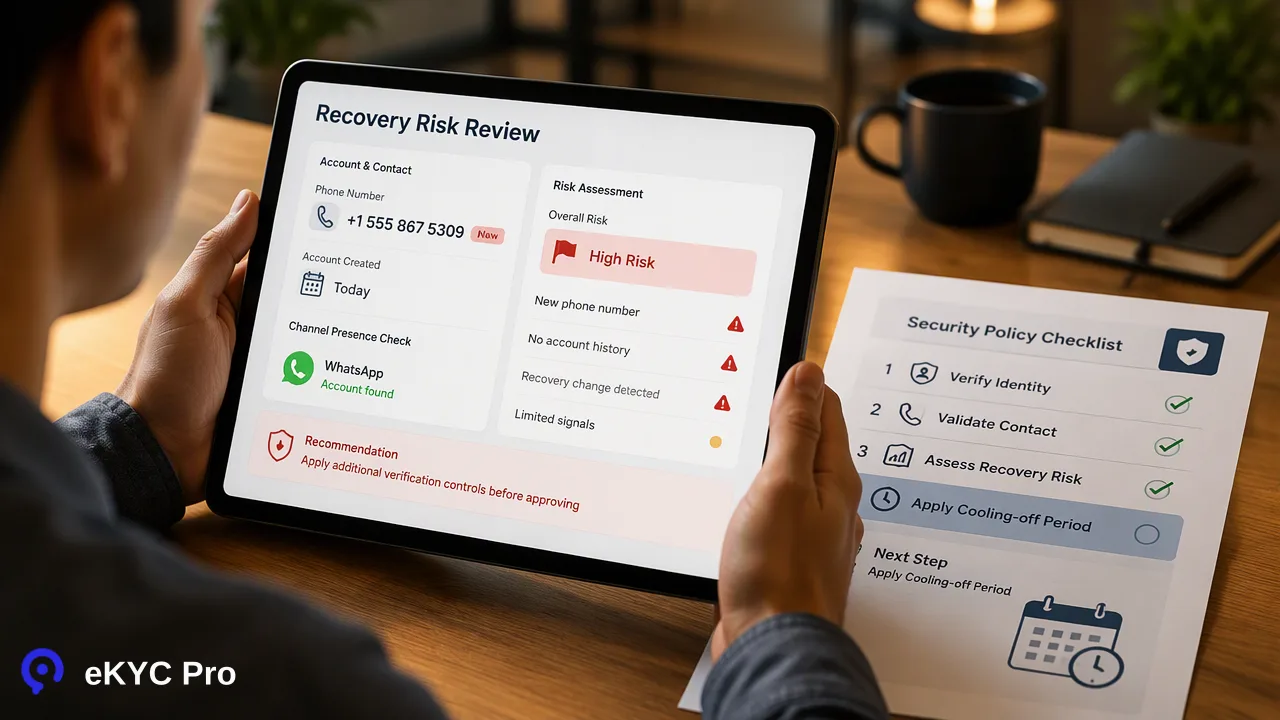
Account recovery risk signals are the facts a team reviews before it approves a recovery request or a change to the phone number or email on an account. The most useful moment to check is the contact-change step, because a takeover usually ends with the attacker’s own number or address on the account.
Why recovery and contact changes attract account takeover
Login screens usually get the strongest controls. Recovery flows often rely on weaker evidence such as a code sent to a channel the attacker has already changed, knowledge questions, or a persuasive support call. Once an attacker replaces the phone number or email on file, later password resets and alerts go to them.
Standards treat this step seriously. NIST SP 800-63B requires that account recovery trigger a notification to the subscriber and that new recovery addresses be confirmed before use (NIST SP 800-63B, Events). The OWASP guidance advises against relying only on recently added or changed recovery information and against automatically re-adding superseded numbers or addresses (OWASP Forgot Password Cheat Sheet).
Most published lists of recovery signals focus on volume metrics or device data. The gap is the new identifier itself: what does the number or address the requester wants to add look like?
Account recovery risk signals to check on the new identifier
Group recovery signals into three layers and check them in order of cost and friction.
Layer 1: Account and request context (internal)
- Time since the last contact change, password reset, or failed recovery attempt.
- Whether the request came through self-service or a support agent.
- Whether the old contact channel is still reachable and has been notified.
- Mismatch between the new number’s country code and the account’s usual country.
Layer 2: Signals on the new phone number
- Carrier and line type. eKYC Pro’s Carrier Lookup returns carrier and line-type signals, including available VoIP or virtual-number context, for one number.
- Platform account presence. Per-call checks such as WhatsApp, Telegram, Viber, or Facebook show whether the number has an account-presence signal on that platform at check time.
Layer 3: Signals on the new email address
- Platform account presence for supported email services such as Apple, Amazon, Facebook, or Instagram.
Each result is one signal about the identifier at check time. None of them shows who is making the request.
A routing matrix for recovery decisions
Routing works best when it is written before launch and reviewed with outcome data. One example structure, which each team should adapt to its own risk appetite:
| Internal context | New-identifier signals | Example route |
|---|---|---|
| Long-standing account, old channel confirmed the request | Ordinary profile for the market | Approve and notify all registered channels |
| No recent changes, old channel unreachable | Ordinary profile | Step-up: saved recovery code or another established factor |
| Recent password reset or several recovery attempts | Little platform footprint, or VoIP/virtual-number context | Manual review before the change takes effect |
| Support-initiated request with pressure to act quickly | Any | Manual review with a cooling-off period on sensitive actions |
| Check indeterminate or timed out | Unknown | Apply the written fallback: usually step-up rather than automatic approval |
The table is an illustration of how teams combine signals, not a product setting. eKYC Pro returns signals; the customer’s rules decide the route.
Choosing Per-call, Combo, or Phone Trust Score for recovery review
- Per-call API: runs one selected service on one identifier. Use it when a rule needs a specific answer, for example carrier and line type on the new number.
- Combo Check API: runs a saved group of phone or email services concurrently on one identifier and returns each result with its billing detail. Use it when the rule looks at several signals together, such as carrier plus two messaging platforms.
- Phone Trust Score API: scores a mobile number from 0 to 100 and returns an A–E grade. Teams typically map grades to routes in their own rules, for example A–B to approve with notification, C to step-up, and D–E to manual review, while keeping the grade as decision support rather than a verdict.
All three handle one identifier per request, which fits the recovery flow: one account, one new number or address, one decision.
Step-up and notification practices that pair with the signals
Signals tell a team where to add friction; the friction itself still has to be well designed:
- Confirm possession of the new identifier with a one-time code or link before it is bound to the account.
- Prefer previously established evidence for step-up, such as saved recovery codes or an existing authenticator, over anything added in the same session.
- Notify every registered channel, including the one being replaced, with clear instructions for disputing the change.
- Apply a cooling-off period on high-risk actions, such as payouts or further contact changes, after a recovery.
- Invalidate outstanding reset links and sessions once the recovery is complete.
- Keep support agents on the same rules. Agent-assisted recovery should use the same signal checks and routes as self-service, so social engineering does not bypass them.
Common mistakes in recovery risk review
- Checking only the old identifier. The new number or address is where a takeover shows up; check it before binding.
- Treating a signal as a verdict. A VoIP context or a thin platform footprint justifies a closer look, not an automatic refusal; many genuine users change carriers or create new addresses.
- Letting timeouts approve. A fail-open rule on recovery gives attackers an easy path; most teams fail toward step-up here.
- Ignoring regional coverage. Numbers from China mainland (+86), Hong Kong (+852), and Macau (+853) support limited real-time single checks, and regional services such as Zalo or BAND cover specific markets only; route those cases with a fallback rule.
- Not closing the loop. Record each signal, route, and later outcome so the team can tune rules with evidence instead of instinct.
FAQ
How can teams decide which recovery requests need step-up authentication?
Combine internal context, such as recent resets or an unreachable old channel, with signals on the new identifier, then map the combinations to routes in a written rule. Cases with several unusual signals usually go to step-up or manual review.
Which account recovery risk signals apply to a new phone number?
Carrier and line-type context, including available VoIP or virtual-number context, and platform account-presence signals on services such as WhatsApp or Telegram. Each describes the number at check time, not the person requesting the change.
How should a recovery flow handle a timed-out risk check?
Most teams send it to step-up rather than approving automatically, because recovery is a common takeover path. Indeterminate or timed-out eKYC Pro service checks are generally not billed.
How can support teams apply the same recovery checks as self-service?
Give agents the same signal results and routing rules inside their case tool, and require the same step-up for agent-initiated contact changes, so a convincing caller cannot skip the checks.
Get Started with eKYC Pro
Explore eKYC Pro’s single-identifier APIs and choose the service-specific, combined-signal, or unified-score workflow that fits your use case.