
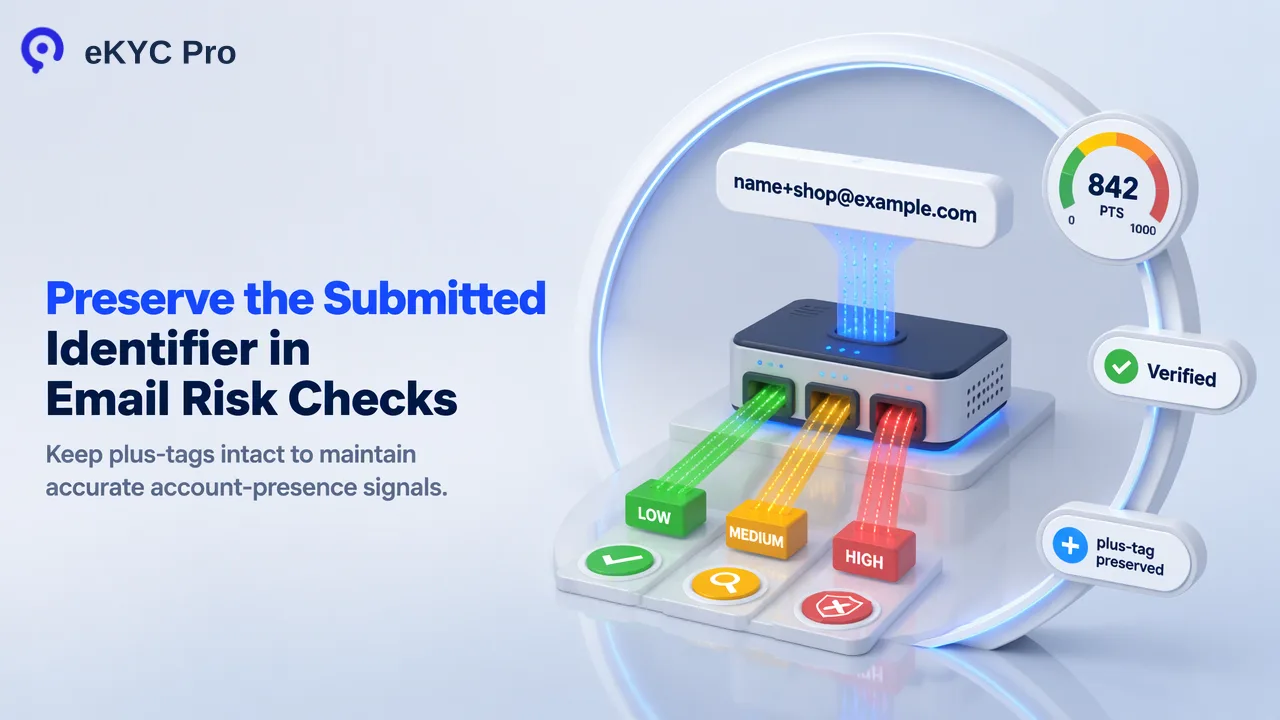
An email risk check with plus addressing should normally use the identifier the person actually submitted. A plus tag can affect mail routing under a provider’s rules, but routing to a mailbox does not establish that a platform treats the tagged and untagged addresses as one account. Record any application-owned normalization separately so reviewers know which address was queried.
What plus addressing changes—and what it does not
A plus tag is text after a plus sign in an address local part, such as [email protected]. Some mail systems route that address to the mailbox used by [email protected]. The provider, however, defines what the local part means. The SMTP specification says the local part is interpreted by the receiving host. Gmail’s alias guidance describes a particular Gmail use of plus addressing; it does not define behavior for every provider or for third-party accounts.
Three questions often get collapsed. Can a message reach a mailbox? Does the exact address appear in a particular service’s records? Does the applicant control the mailbox? Those questions need different evidence. Even when two addresses route to one inbox, a service might store the exact string entered at registration, normalize it, or apply its own alias policy. An email risk result should therefore be attached to the queried string and selected service, not silently promoted into a statement about every alias of that mailbox.
This matters at signup because a harmless looking preprocessing step can change the subject of the lookup. A user who entered [email protected] may receive mail there, while a check of [email protected] asks a different account-presence question. That distinction remains important even if the application considers the two addresses related for its own duplicate-account review.
Set an explicit email-input preservation policy
Keep the submitted email value as an immutable record for the current review event. Validate that the input is usable for the application, then decide whether any display or storage normalization is needed. Treat trimming surrounding form whitespace as a separate input-cleaning decision; do not quietly remove plus tags, dots, or characters in the local part as a universal identity rule. The email address architecture treats that local part as opaque outside the receiving domain.
If the team maintains a canonical key for internal grouping, retain it alongside the original rather than replacing the original. Label the key as application-owned. It may help locate potentially related submissions, but it is not the identifier that the person supplied and should not be reported as a provider-confirmed alias. Reviewers need to see both values and the transformation rule when the two differ. Make the policy version visible in operational records so a later rule change does not rewrite the meaning of an older check.
A useful implementation review asks four concrete questions: Which exact value was submitted? Which exact value was sent for the selected check? Was a second derived value created solely for internal matching? What rule created that derived value? If the answers cannot be recovered, a later analyst may mistake an application transformation for evidence returned by a service.
Choose the check by the question the team needs answered
eKYC Pro accepts one supported email identifier per request for applicable services. Its Per-call API overview describes a selected service; the current API documentation should be consulted before integration for available service names and contract details. Select the service according to the actual review question, rather than assuming every email check measures the same thing.
For Outlook/Hotmail, Yahoo, and iCloud, Email Check concerns mailbox existence. For Gmail, Yandex, and Mail.ru, the relevant Email Check and unified Email Avatar capability concerns public-avatar availability. No public avatar does not establish that the mailbox is absent. An account-presence result from another selected service is likewise a service-specific signal, not a statement of control, consent, or identity. Keep these interpretations separate in the reviewer view.
When the input contains a plus tag, evaluate whether the selected service documents support for that exact provider and identifier. If the available facts do not establish alias handling for that service, the safe description is limited to the submitted identifier and returned signal. Do not infer that a completed check has also checked the base address. Likewise, do not infer that two checks using related strings must return the same result.
Test and explain the decision path
Use controlled test identifiers that the team is authorized to use. Compare the application’s stored submission, selected service, outbound identifier, and displayed interpretation. The aim is to test the application’s mapping, not to assert how an undocumented external platform stores aliases. Include a tagged address and an untagged address as separate test inputs; record whether the application changed either value before the check. A mismatch between the form value and the check value should be visible as a review defect.
For a completed result, show the exact checked identifier, check time, selected service, and a plain-language interpretation of that service’s signal. For an indeterminate or timed-out service check, preserve that operational state instead of presenting it as a negative result. If the applicant later edits the address, bind the response to the older submitted value and avoid attaching it to the new form state. These are application workflow choices that protect the meaning of the evidence.
Teams can use a separate step-up or human review when their policy calls for stronger evidence. They should not treat plus-tag removal, an avatar, or a platform presence signal as proof that a person owns or controls an address. The value of an email risk check lies in a clear, narrow question and a traceable answer, not in a universal normalization shortcut.
FAQ
Should teams remove a plus tag before an email risk check?
Usually no. Preserve the submitted identifier and check the selected service using the value the review intends to evaluate. Any derived alias key should be labeled as an application rule.
Does a Gmail plus alias prove the base address and tagged address are one platform account?
No. Gmail documents a mail-routing use of plus aliases; a separate platform may use its own account rules. The result applies to the identifier and service actually checked.
How should teams interpret a missing public avatar?
For Gmail, Yandex, and Mail.ru avatar-oriented checks, no public avatar is an avatar signal. It does not establish that the mailbox does not exist.
What should a reviewer see after a transformed email input?
Show the submitted value, the checked value, the transformation policy, and the selected service. Keep application-derived grouping separate from the returned signal.
Get Started with eKYC Pro
Explore eKYC Pro’s single-identifier APIs and choose the service-specific, combined-signal, or unified-score workflow that fits your use case.