
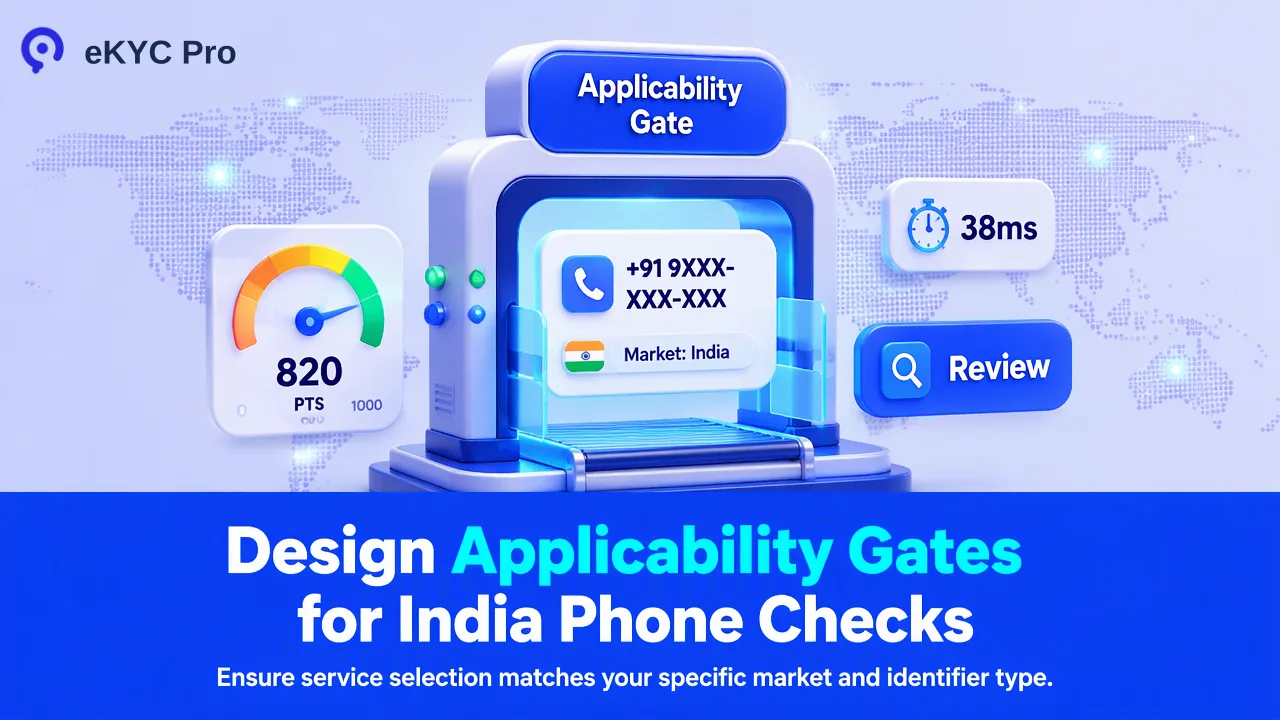
An Indiatimes account checker API belongs in a review flow only when the submitted identifier is a phone number and the India-specific service answers a defined question. eKYC Pro documents an IndiaTimes phone account-presence signal in its single-identifier service catalogue. A completed signal can inform a customer-owned review rule; an indeterminate check or a result outside the service’s scope should not be converted into an identity conclusion.
Put an India applicability gate before service selection
The first implementation question is not how to score a result. It is whether this service is applicable to the submitted number and the business question. The eKYC Pro profile describes IndiaTimes Check as a phone-number account-presence signal in India. Therefore, an application should select it only when its own routing information supports that India-specific use. A number’s country code can be one input to routing, but the team should not assume that a number proves where the person lives or which services they use.
An applicability gate can be documented in customer-owned terms: the value is a phone identifier; the selected market for this review is India; the question is account presence on IndiaTimes; and the reviewer has a defined action for each possible outcome. If any condition fails, do not send the value to an unrelated service and reinterpret what comes back. An unsupported or irrelevant check adds ambiguity rather than useful evidence.
The Per-call risk signal API describes the product mode suited to one selected service and one identifier. The API documentation should supply the current integration details. This article does not assert a request path, parameter name, response field or timeout because those are not present in the trusted article facts.
Separate service completion from account presence
A review system needs at least two questions at interpretation time. Did the selected service complete with a determinate outcome? If it did, what does that outcome mean within the service’s account-presence scope? If it did not, the application should follow its policy for unavailable information. It must not relabel a timeout as “no account” or a processing failure as “high risk.” Those are different states.
This separation should be visible in the customer’s own decision record. A suggested record includes the selected service, submitted identifier, applicable market, time of the observation, whether the check was determinate, the narrow account-presence interpretation when available, and the rule that chose the next action. These are recommended application-owned fields, not a claim that the API returns this exact schema. Keep sensitive identifiers appropriately protected in logs and reviewer displays according to the organization’s own policy.
A completed IndiaTimes presence signal is not a general statement about phone validity, current user activity, ownership or consent. It can support a branch in a risk-review workflow alongside other evidence. If the team’s decision requires proof that the applicant controls the phone, a separate mechanism is needed. NIST’s identity-proofing overview draws a broader distinction between an attribute and evidence used to verify the person behind it.
Design next actions before the first production call
Define how the team uses each category of information. A determinate result that fits a customer-defined rule might continue ordinary processing, prompt a question, or go to a reviewer. An indeterminate result might defer the decision or take a conservative route. These are design choices, not eKYC Pro defaults. Avoid writing “approve if present” or “reject if absent” without evidence that such rules fit the business’s actual risk and user experience.
Test the application-owned gate with representative input categories: a phone number in the intended market, a phone number outside that market, an email address, a changed value while a call is underway, and a service outcome that cannot be interpreted. This is an integration test plan, not a fabricated product benchmark. Confirm that each scenario keeps the original identifier tied to its own check and that no inapplicable result reaches the final decision.
Have reviewers see why the service was selected. If they only see “IndiaTimes check,” they may wrongly infer that the user is in India or has a verified identity. A short explanation of the selection rule helps prevent that overreach. Review those rules when the business enters a new market or changes its signup form.
Maintain a narrow, reviewable conclusion
The service’s value is specificity. It answers an account-presence question for one phone number within its documented regional scope, as part of a synchronous single-identifier workflow. That is a useful input when the organization has a corresponding review decision. It does not become more authoritative by combining it with a broad, unexplained “trust” label.
Set up a periodic review of cases where staff overrode the initial route. Look for confusion about market applicability, unknown outcomes and the difference between presence and control. Record whether a branch was useful, not whether a result “proved” a person’s behavior. This feedback can improve the customer-owned rule without inventing an accuracy rate for the service.
If the team later uses other eKYC Pro modes, keep them separate: Combo Check runs a saved group of services on one identifier, while Phone Trust Score is a separate decision-support output. Neither should be silently substituted for the selected IndiaTimes Per-call question. The reviewer should always know which question was actually asked.
FAQ
When is the IndiaTimes service relevant?
When the submitted value is a phone number and the customer’s review concerns India-specific IndiaTimes account presence.
Does an IndiaTimes signal verify the phone owner?
No. It is a selected platform account-presence signal and does not establish ownership, identity, consent or current activity.
How should teams handle an indeterminate check?
Follow an explicit policy for unavailable information; do not treat it as a completed negative account-presence finding.
Should developers reuse the same rule for other markets?
No. Regional services have their own coverage and should be selected only when the business question and identifier fit that scope.
Get Started with eKYC Pro
Explore eKYC Pro’s single-identifier APIs and choose the service-specific, combined-signal, or unified-score workflow that fits your use case.