
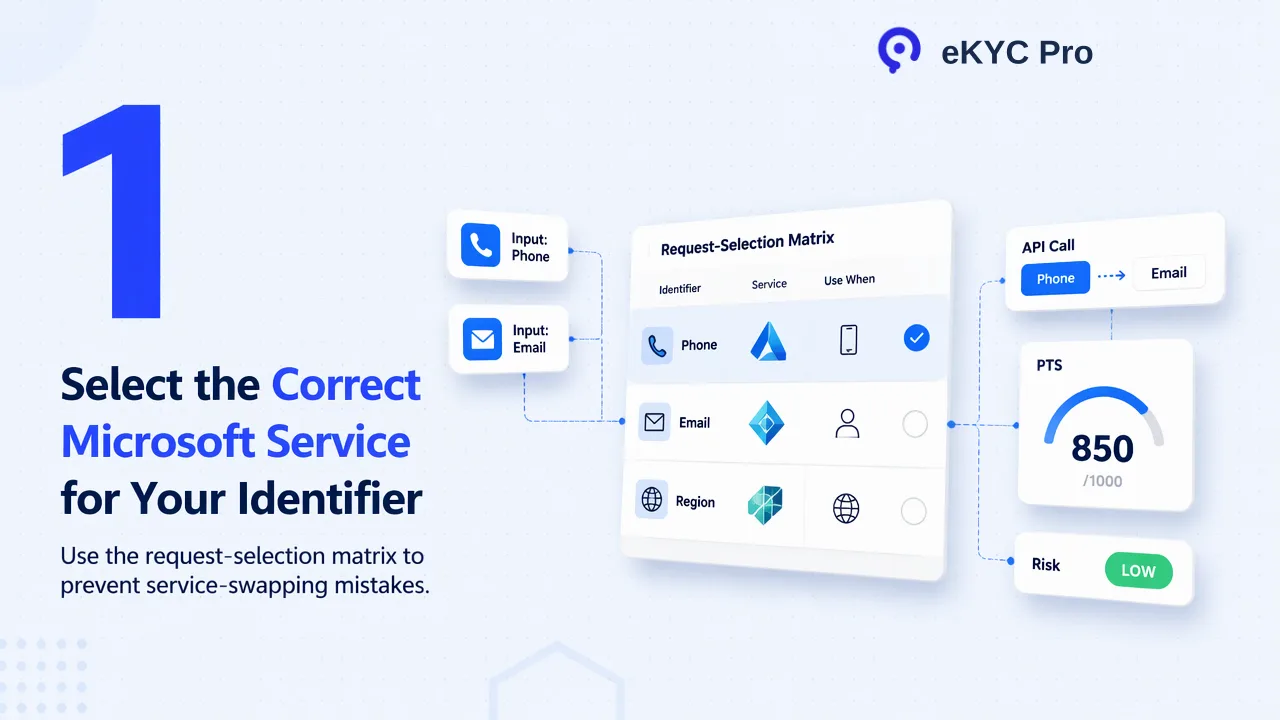
A Microsoft account check by phone and an Outlook mailbox-existence check answer different questions. The phone-selected Microsoft service supplies a platform account-presence signal for one submitted number; the supported Outlook or Hotmail Email Check asks whether a mailbox exists for one submitted email address. Neither establishes that the applicant controls the identifier or is the person behind an account.
Start with the identifier the applicant actually submitted
An integrator should first ask what the form collected and what decision the result would inform. If the person supplied a phone number and the review question concerns Microsoft account presence for that number, the Microsoft phone service is the relevant choice. If the person supplied an Outlook or Hotmail email address and the question concerns whether that mailbox exists, the supported Email Check is the relevant choice. Do not swap a number for an email simply because both can be associated with the Microsoft ecosystem. They are different identifiers and different signal meanings.
The product profile documents eKYC Pro Microsoft Check as a phone-number account-presence signal. It documents Email Check as mailbox existence for Outlook/Hotmail, Yahoo and iCloud, while Gmail, Yandex and Mail.ru are public-avatar availability only. This domain distinction matters: an integrator should not treat every email-domain result as mailbox existence. The email checks page helps readers explore the supported email questions, while the Per-call risk signal API is the relevant integration path for a selected service.
Write the review question before choosing the service. “Is this submitted Outlook mailbox present?” and “Does this submitted phone number produce a Microsoft account-presence signal?” are precise enough to guide selection. “Is this person real?” is not, because neither service answers it.
Use a request-selection matrix
A short matrix keeps the application from choosing by brand name alone. The rows below describe a customer-owned selection rule, not an API payload or provider response schema.
| Submitted value | Review question | Relevant documented signal | What remains unknown |
|---|---|---|---|
| Phone number | Microsoft account presence for this number? | Microsoft Check | Who controls the number or account |
| Outlook/Hotmail email | Does this mailbox exist? | Email Check | Who can open or operate the mailbox |
| Other supported mailbox domain | Does that supported mailbox exist? | Email Check where documented | Whether it belongs to the applicant |
| Gmail, Yandex or Mail.ru email | Is a public avatar available? | Email Check within that scope | Mailbox existence if no avatar appears |
| Email with no documented support | No supported question selected | Do not infer a result | Existence and ownership |
The matrix prevents a common mistake: treating a phone result as a mailbox check or a mailbox result as a Microsoft account linkage. It also forces a decision for unsupported input rather than silently asking the wrong service. If the team has both phone and email, consider them two separately submitted identifiers with separate review questions. Do not merge their outputs into a claim that they identify one person.
Interpret completed, unclear and unavailable checks distinctly
A completed result can inform the selected question, within the service’s scope. A timed-out or indeterminate service check is not the same as a negative finding. eKYC Pro generally does not bill indeterminate or timed-out service checks, but billing behavior is not a risk interpretation. In an inline flow, decide whether the application asks for another action, continues with a review marker, or defers a decision. That policy belongs to the customer.
Do not infer a guaranteed response time from the synchronous design. The application should keep the submitted identifier attached to the result it requested. If a person edits the phone or email field while the call is in progress, the older outcome must not be shown as though it evaluated the new value. This is a general integration correctness rule, not an assertion about eKYC Pro’s internal response envelope or a particular UI control.
For account presence, remember that the selected platform signal is at check time and does not show identity, ownership, intent, or consent. For mailbox existence, remember that an existing address does not prove the applicant can read it. NIST’s identity-proofing overview explains that identity proofing requires separate evidence and verification steps. A presence or existence signal should stay in its narrower role.
Write reviewer language that preserves the distinction
Reviewer notes should state the selected service, submitted identifier type, observed check time and the narrow conclusion. They should not collapse the finding into “Microsoft verified.” A useful note might say, as an illustrative internal wording, “Microsoft phone account-presence signal checked for the submitted number; ownership not established.” For Outlook, it might say, “Supported mailbox-existence question checked for the submitted Outlook address; access by applicant not established.” These examples are suggested customer-owned notes, not actual response fields.
Train reviewers to ask the next relevant question. If the process needs to establish access, use an appropriate separately designed confirmation step. If it needs identity proofing, use evidence suited to that purpose. If it only needs a contextual risk input, keep the check as one part of a broader rule. Do not use a missing platform signal to declare a person fraudulent or a present signal to approve them automatically.
The current API documentation should be consulted for service selection and integration details. This article intentionally does not invent endpoints, headers, fields, or response values. A careful service-selection matrix reduces interpretation errors before code is written.
FAQ
How can teams choose between Microsoft phone and Outlook email checks?
Choose according to the submitted identifier and the exact question: Microsoft account presence for a phone number or Outlook/Hotmail mailbox existence for an email address.
Does an Outlook mailbox-existence result prove applicant control?
No. The existence question is narrower than access or ownership; use a separate method if control must be established.
Can a Microsoft phone signal be used as an Outlook mailbox result?
No. They concern different identifiers and distinct services.
What should a reviewer record for either check?
Record the selected service, submitted identifier type, check time and narrow result meaning, while avoiding a claim of identity verification.
Get Started with eKYC Pro
Explore eKYC Pro’s single-identifier APIs and choose the service-specific, combined-signal, or unified-score workflow that fits your use case.