
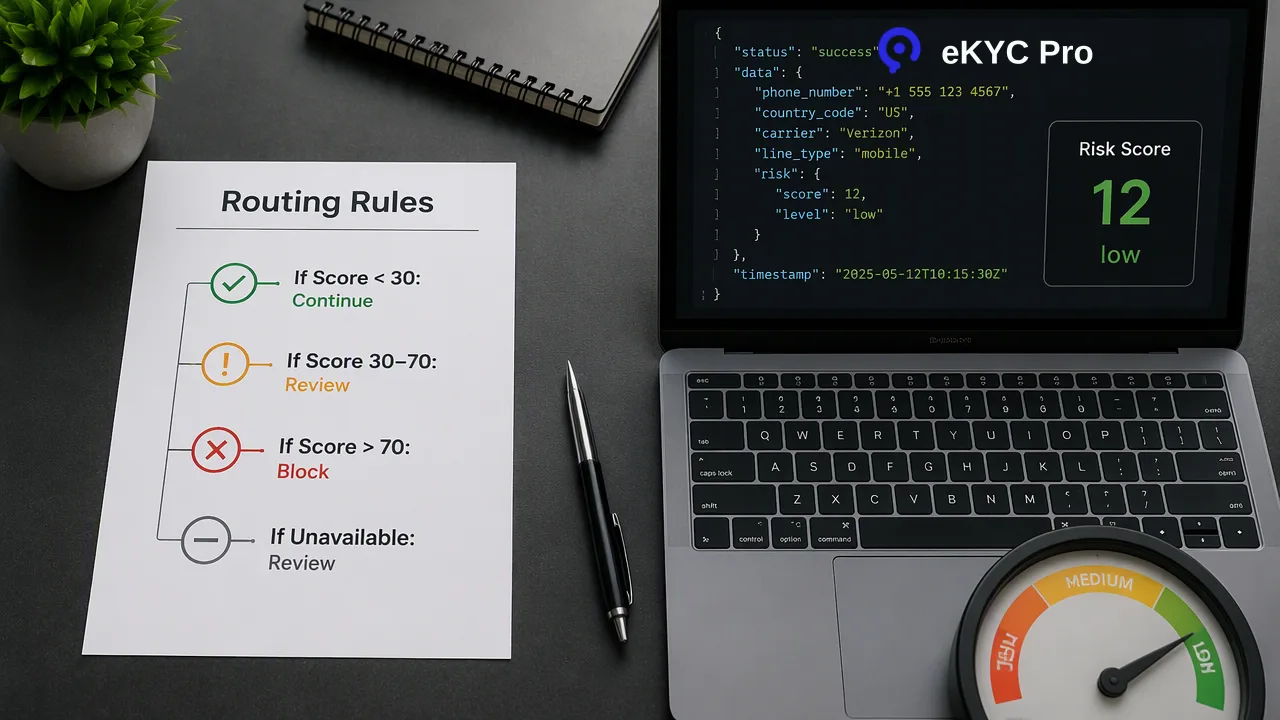
A phone risk score API takes one phone number at signup and returns a risk-oriented result that an onboarding rule can act on: continue, ask for a step-up, or send the case to review. It belongs early in the flow, after the number is normalized and before costly steps such as code delivery, credit checks, or manual review. The score is decision support, not a verdict, so it works best alongside other controls, with routes, fallbacks, and review rules that the business defines and tunes.
What a phone risk score API returns
Search results for this topic mostly show vendor reference pages, and they disagree on the shape of the answer. Some return a numeric score, some return a level such as low, medium, or high, and some return the underlying signals and leave the scoring to the customer. Infobip, for example, describes its Number Risk Score as a risk level plus signal events, intended to supplement existing authentication and fraud systems rather than replace them.
For an onboarding team, the useful distinction is between three kinds of output:
- Raw signals. A single fact observed at check time, such as an account-presence signal on a named platform or carrier and line-type context for the number.
- Aggregated signals. Several raw signals for the same number, returned together so a rule can compare them.
- A score or label. A combined result designed to be read by a rules engine or an analyst without inspecting each signal.
Each layer trades transparency for convenience. A raw signal is easy to explain in a review note but needs more rule logic. A score is easy to route on but harder to explain to an applicant or an auditor. Most mature onboarding flows keep both: the score drives routing, and the underlying signals stay available for the reviewer.
Where a phone risk score API sits in the onboarding sequence
The top-ranking pages describe what a score is but rarely say where in the flow the call should happen. Placement matters because it decides which costs the score can help avoid.
A common sequence looks like this:
- Capture and normalize. Convert the entered number to international format with a country code, using a library such as Google’s libphonenumber. Reject or correct numbers that cannot be parsed before spending an API call.
- Run the risk check. Send one number to the risk API while the applicant is still on the form or on the next screen.
- Apply the rule. Map the result to a route the business has defined in advance.
- Deliver the next step. Continue, ask for an extra factor, collect more information, or hold the account for review.
- Record the decision. Store the result, the rule version, and the route so later reviews can see why the decision was made.
Running the check before a one-time code is sent is a frequent choice. NIST’s SP 800-63B treats phone-based out-of-band authentication as a restricted option and says verifiers should consider risk indicators such as SIM change and number porting before using the phone network to deliver a secret. A risk check at this point can inform whether a code is the right next step or whether a different factor fits better.
Three ways eKYC Pro delivers phone risk signals
eKYC Pro offers three separate API models for one phone number or supported email identifier per request. They are different products with different outputs, and an onboarding design should pick deliberately rather than treat them as interchangeable.
| Model | What it runs | What it returns | Access |
|---|---|---|---|
| Per-call API | One selected service, such as a platform account-presence check or Carrier Lookup | That service’s documented result | Standard API access |
| Combo Check API | A saved group of phone or email services, run concurrently on one identifier | Each service result with its billing detail | Standard API access |
| Phone Trust Score API | Several live checks on one mobile number combined into one assessment | A 0–100 score and an A–E grade | Self-serve with an API key |
How teams typically choose:
- Per-call suits a flow that needs one specific fact, for example carrier and line-type context, including available VoIP or virtual-number context, before deciding whether to send a code.
- Combo Check suits a team that wants several platform signals for the same number and prefers to write its own rules over them.
- Phone Trust Score suits a team that wants a single score and grade to route on.
Coverage depends on the selected service and identifier type. eKYC Pro positions its coverage across 20+ platforms, and some services are regional: Shopee and GoTo target Indonesia, BAND targets South Korea, Zalo targets Vietnam, IndiaTimes targets India, and VK and HeadHunter target Russia.
Turning a phone risk score into onboarding routes
A score has no effect until a rule maps it to an action. Write that mapping down before launch, and treat it as a business policy rather than a product setting.
An example mapping some teams start from when routing on the grade:
| Label | Example route | Example follow-up |
|---|---|---|
| A–B | Continue onboarding | Standard monitoring after signup |
| C | Step-up or light review | Extra factor, or a second signal before approval |
| D–E | Hold for manual review | Analyst checks the case before account features open |
These routes are examples, not requirements. A lending product may hold C-grade cases, while a low-value content signup may let them continue with monitoring.
Guidelines that keep the mapping useful:
- Route, do not just reject. A D or E grade with an automatic decline removes the chance to learn from false positives. A review queue keeps that feedback.
- Combine with context. The same label can mean different things on a gift-card checkout and on a newsletter signup. Rules can weigh the product, amount, and region together with the score.
- Version the rule. Store which rule version made each decision so changes can be compared.
- Tune against outcomes. Compare routed cases with later chargebacks, abuse reports, and review results, then adjust the mapping. Thresholds belong to the business and should move with evidence.
Timeouts, indeterminate results, and missing data
A synchronous risk check will sometimes fail to return a usable answer. The flow needs a default for that moment, and it should be decided per step rather than once for the whole system.
- Fail-open lets the applicant continue without the signal and flags the case for later review. It fits reversible, low-value steps.
- Fail-closed holds the step until a usable answer exists or routes it to a person. It fits hard-to-reverse steps such as a first payout.
Practical points for eKYC Pro integrations:
- An indeterminate or timed-out service check is generally not billed, so a retry policy can focus on applicant experience rather than cost.
- Set an explicit client timeout and retry at one layer only, so a slow dependency is not hit by several layers of retries at once.
- Log missing results as their own category. A missing result is not a good result, and treating it as one hides gaps from reporting.
- Alert on rising failure rates. A fail-open flow can run without the signal for hours if nobody is watching.
Regional coverage and number hygiene
Score quality starts with input quality. Many weak results trace back to numbers sent without a country code, with a trunk prefix left in, or with spaces and punctuation that a parser handles differently.
A short checklist:
- Store the number in international format, and record the country the applicant selected separately.
- Compare the parsed country with the market the applicant claims; a mismatch can be a review input on its own.
- Know the regional limits of the services in use. China mainland (+86), Hong Kong (+852), and Macau (+853) numbers support limited real-time single checks, and regional services cover their own markets only.
- Do not read a missing regional signal as a negative finding. A BAND result is meaningful for South Korean numbers, not for numbers elsewhere.
Governance: review, explanation, and record keeping
Automated onboarding decisions attract scrutiny, and a phone risk score is easier to defend when the process around it is documented.
- Keep a human path. Under GDPR Article 22, people have rights around decisions based solely on automated processing that significantly affect them, including, in the permitted cases, the right to obtain human intervention and contest the decision. A review route for low-grade or disputed cases supports that.
- Explain with signals, not with the number. Reviewers and support staff work better with service-level evidence, such as Per-call or Combo Check results, than with a score alone.
- Describe the output accurately. A 0–100 score and an A–E grade are decision-support outputs for customer-defined rules. An account-presence signal shows presence on a platform at check time; it says nothing about who holds the number or whether the applicant consented.
- Retain only what is needed. Keep the result, the rule version, and the route for the period the business requires, and document that period.
Common mistakes when adding a phone risk score API
| Mistake | Why it hurts | Better approach |
|---|---|---|
| Declining every D or E case automatically | Removes the feedback needed to tune rules | Hold for review and record the outcome |
| Treating a missing result as a good score | Hides outages and coverage gaps | Track missing results separately |
| Sending unnormalized numbers | Produces weak or misleading results | Normalize to international format first |
| Mixing up products | Expects a score from a single-service call | Choose Per-call, Combo Check, or Phone Trust Score by the output needed |
| Using one global threshold | Ignores differences between products and steps | Set routes per step and per product |
| Never revisiting the mapping | Rules drift as abuse patterns change | Review outcomes on a fixed schedule |
FAQ
How can teams decide between a phone risk score and individual signals?
Teams that want one value to route on often choose a score such as the Phone Trust Score grade. Teams that prefer to write their own rules, or need to explain each decision in detail, often start with individual Per-call results or a Combo Check group. Many keep both: the score routes the case and the signals support the reviewer.
When should the phone risk check run during onboarding?
Usually after the number is normalized and before expensive or sensitive steps, such as sending a one-time code, running a credit check, or opening features that move money. Running it at that point lets the result inform which next step is appropriate.
What should a signup flow do when the risk check times out?
Decide per step. Low-value, reversible steps often continue and flag the case for later review, while high-value steps hold the action or route it to a person. Record timeouts as their own category so they are not counted as low-risk results.
How often should teams revisit their score-to-route mapping?
On a fixed schedule, such as monthly or quarterly, and after any notable change in abuse patterns or product launches. Compare routed cases with later outcomes, including review decisions and chargebacks, and adjust the routes where the evidence supports it.
Get Started with eKYC Pro
Explore eKYC Pro’s single-identifier APIs and choose the service-specific, combined-signal, or unified-score workflow that fits your use case.