
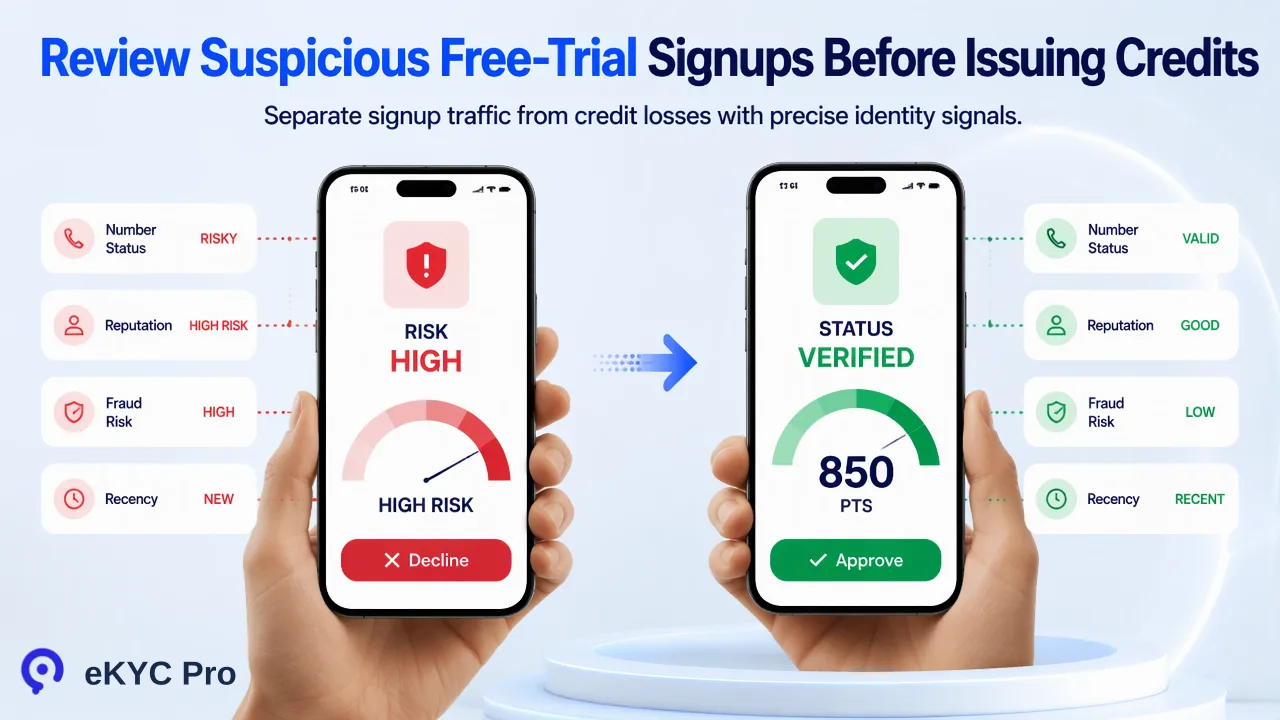
When signups rise without a corresponding rise in customers using the trial, separate three events before changing your onboarding flow: a request for verification, a completed verification, and a credit redemption. Each has a different cost. A phone check can inform the next decision, but the evidence that credits are being consumed comes from your own trial ledger.
Find the step where the cost appears
Suppose your dashboard shows a busy afternoon for a new design tool. There are many new signups and the messaging bill is rising. The team suspects the free trial, but the first question is whether anyone has actually used the trial benefits. Compare challenge requests, challenge completions, trial grants and credit redemptions for the same time interval and acquisition route. Keep retries distinguishable from first attempts so a delivery problem does not look like a sudden wave of new accounts.
An increase in sends with few completions puts the investigation near the messaging step. Check for a broken form, an unusual retry pattern or a concentration of traffic that warrants review. If completions and redemptions both rose, look at when the granted credits were used and whether legitimate campaign activity explains the increase. If traffic rose after a launch announcement and product use looks normal, restricting every applicant could damage the very campaign that succeeded.
Keep these observations separate even when they happen in one session. Successfully entering a code demonstrates access to the challenge destination at that point. It does not tell you whether the same benefit has already been granted under a different registration.
Use number context for a specific decision
When a particular signup needs review, our per-call API can add context for one submitted number. Choose the lookup that answers the question you actually have. For example, a carrier lookup can supply available line-type information. A supported messaging-account check can supply a service-specific registration observation. Neither lookup returns your internal credit-redemption history.
A reviewer might see several signups linked by an internal billing reference, a short sequence of repeated grants and similar usage immediately after each grant. A phone observation is one additional piece in that review. The cluster of grants matters because it connects to the benefit the team is trying to protect. Two unrelated applicants having the same carrier or the same line type is a much weaker connection. Do not treat that shared attribute as a reason to deny both applicants.
If the lookup returns no usable answer, record it that way. Decide in advance what the existing trial policy permits for ordinary signups with incomplete data. For a legitimate applicant, an alternative confirmation route or a review of the grant may be more useful than repeated requests for the same phone code.
Separate the challenge decision from the credit decision
Consider two different outcomes. A signup generates a series of challenge requests but never completes onboarding. A control at the request step can limit further verification cost while support investigates deliverability. In another case the applicant completes verification successfully, then seeks a further grant your trial terms restrict. A hold on that additional benefit addresses the disputed grant without revoking unrelated access that the customer is entitled to use.
Give support a way to understand either action. A useful note identifies the requested benefit, the observed events and the next permitted step. “Grant pending review after a second redemption under the same internal account reference” is more actionable than a label such as “bad phone.” If a customer appeals, someone can inspect what linked the events, correct an error and release a justified grant.
Test the review rule against a completed cohort
Choose a recent, fully observed interval and replay the proposed rule against the records you were authorized to use. Count how many challenge requests would have been held, how many verified customers would have been delayed and how many disputed redemptions were later confirmed. Measure the money or credits attached to those redemptions separately from SMS cost. A rule that cuts messages can still leave duplicate grants untouched.
Read a few ordinary cases from the group that would have been affected. Check whether shared work contact details, accessibility needs or a genuine delivery issue explain what first looked unusual. Start with one small decision you can reverse and identify the reviewer responsible for exceptions. The test succeeds when the team can explain which cost it changed, what evidence supported each intervention and how a real customer can continue.
Get Started with eKYC Pro
Explore eKYC Pro’s single-identifier APIs and choose the service-specific, combined-signal, or unified-score workflow that fits your use case.