
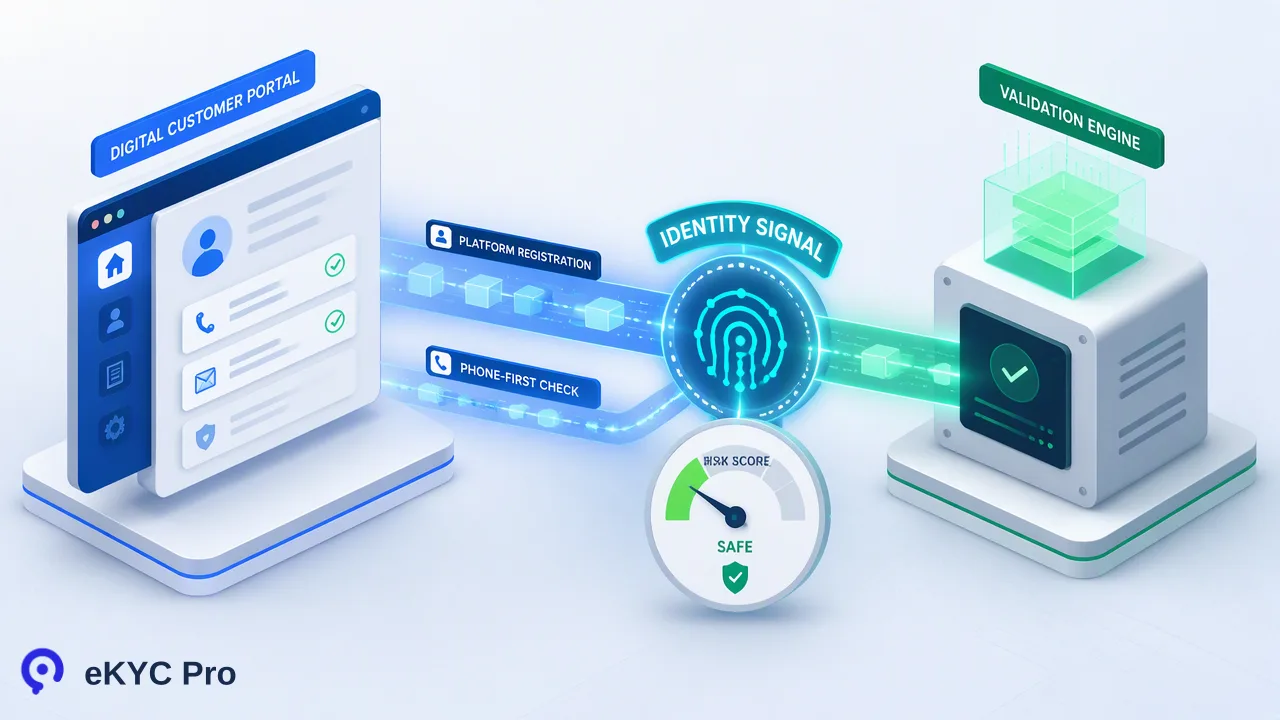
Telecom fraud has expanded beyond traditional network-infrastructure manipulation to include application-layer exploits such as synthetic account creation and account takeover across digital customer portals. Because legacy carrier monitoring tools concentrate on network telemetry like Call Detail Records (CDRs), they lack visibility into malicious interactions targeting web and mobile interfaces. Effective telecom fraud prevention requires a dual-layered defense strategy that pairs traditional network oversight with synchronous identity signals—such as account-presence checks across phone and email identifiers—to inform risk decisions at the point of entry.
The Evolution of Telecom Fraud
Historically, telecom fraud centered on the physical and signaling layers of telecommunications infrastructure. Common attack vectors included international revenue share fraud (IRSF), PBX hacking, interconnect bypass, and unauthorized traffic rerouting. Telecommunications operators built sophisticated fraud management systems designed specifically to ingest and analyze Call Detail Records (CDRs), SS7 signaling, and carrier-to-carrier routing anomalies to detect these schemes. While infrastructure-level attacks continue, the rapid digitization of carrier operations has introduced an expansive new attack surface: self-service customer portals, mobile applications, and web-based provisioning interfaces. Fraudulent actors now deploy application-layer techniques to exploit customer-facing portals. Common vectors include synthetic identity creation to obtain service lines, automated credential stuffing to execute account takeovers, and unauthorized SIM swaps or eSIM provisioning requests. Legacy carrier monitoring tools are structurally unequipped to identify these portal-based threats. Network infrastructure tools analyze call duration, signaling paths, and volume spikes across physical towers and switches. As a result, attacks conducted through web portals bypass traditional network defenses undetected until financial losses or subscriber disputes materialize.
Why Digital Portals Require New Defense Strategies
Digital portals serve as the central entry point for customer onboarding, account management, line additions, and device upgrades. These workflows demand rapid, self-directed access, creating an inherent tension between user convenience and account security. Fraudulent actors exploit this environment by targeting weak identity verification and fragile authentication checkpoints. In synthetic identity fraud, perpetrators combine fabricated personal details with newly registered or inactive phone numbers and disposable email addresses. However, synthetic identities frequently lack the organic digital footprint typical of genuine consumer profiles. Similarly, account takeover operations rely on automated testing of leaked credentials or social engineering at password-reset forms. When an attacker attempts to redirect two-factor authentication or assign an eSIM to a new identifier, relying solely on network-level checks leaves the portal exposed. Securing digital entry points requires evaluating the contextual footprint of the submitted identifiers during the interaction.
Implementing a Dual-Layered Defense
A comprehensive telecom fraud prevention framework requires a dual-layered defense that unites traditional infrastructure controls with ongoing digital identity signals. Rather than replacing network monitoring, organizations must complement it by establishing distinct checkpoints across both operational layers. | Defense Layer | Primary Data Inputs | Focus Areas | Key Limitations | |---|---|---|---| | Network Layer | Call Detail Records (CDRs), SS7/Diameter signaling, tower telemetry | IRSF, traffic rerouting, PBX compromise, volume anomalies | Blind to web session behavior and synthetic onboarding details | Pairing traditional CDR monitoring with synchronous identity signals establishes defense-in-depth. Network-level monitoring continues to safeguard voice and data routing across carrier infrastructure, while digital identity verification assesses the coherence and presence of identifiers interacting with customer portals. This combination helps organizations detect anomalous behavior before malicious actors can finalize account creation or execute unauthorized account takeovers.
Leveraging Identity Signals for Risk Decisioning
Integrating digital identity signals into customer portal workflows allows risk engines to make informed routing and verification decisions. Platforms like eKYC Pro provide phone-first synchronous single-identifier checks, with supported email checks available on applicable products, enabling teams to evaluate individual identifiers during portal interactions. A foundational input in this workflow is the platform registration signal. At check time, a registration check verifies whether a submitted phone number or email address exists on a specific external platform. Through Per-call checks, an organization can query a single service synchronously to obtain that service’s registration signal. Because genuine users typically maintain consistent account presence across major consumer platforms, an identifier that completely lacks presence can serve as a valuable risk indicator. To streamline multi-signal evaluation, the Phone Trust Score API runs several live checks on one mobile number in parallel and returns a 0–100 score with a grade from A to E and reason codes that explain what lowered the score. Fraud decision engines use these outputs to support customer-defined business rules, for example:
- Grades A–B: Identifiers showing established, coherent platform presence can proceed through automated onboarding or self-service workflows. - Grade C: Identifiers with partial footprints or minor discrepancies can be routed to stepped-up verification, such as secondary document review or out-of-band validation. - Grades D–E: Identifiers displaying significant incoherence—such as an email address with broad service presence paired with a newly generated phone number showing zero platform presence—can be directed to manual fraud review before account creation or profile modification is permitted. By treating synchronous identity signals as decision-support inputs, organizations reinforce their digital portals against telecom fraud without disrupting genuine subscriber interactions.
FAQ
Why are legacy network monitoring tools insufficient for modern digital fraud?
Legacy network monitoring focuses on Call Detail Records (CDRs) and signaling traffic across carrier infrastructure to detect issues like interconnect bypass or unauthorized routing. Modern portal fraud operates at the application layer, where bad actors use automated scripts or synthetic identities to exploit web and mobile interfaces. Because these interactions mimic ordinary web traffic, network-level monitoring cannot observe or evaluate the risk indicators associated with the submitted user identifiers.
How do platform registration signals support account takeover defense?
Platform registration signals indicate whether a submitted phone number or email address has an active presence on a specific external digital service at the moment of the check. In account recovery or credential change workflows, an identifier that completely lacks established platform presence can serve as a risk signal.
What role does a risk score play in portal fraud workflows?
A risk score, such as the 0–100 Phone Trust Score paired with an A–E grade and reason codes, synthesizes several live checks on a single mobile number. Fraud decision engines consume these outputs to route incoming requests into customer-defined workflows, such as approving low-risk requests automatically, flagging moderate anomalies for secondary verification, or pausing high-risk submissions for manual evaluation.
Get Started with eKYC Pro
Explore eKYC Pro’s single-identifier APIs and choose the service-specific, combined-signal, or unified-score workflow that fits your use case.