
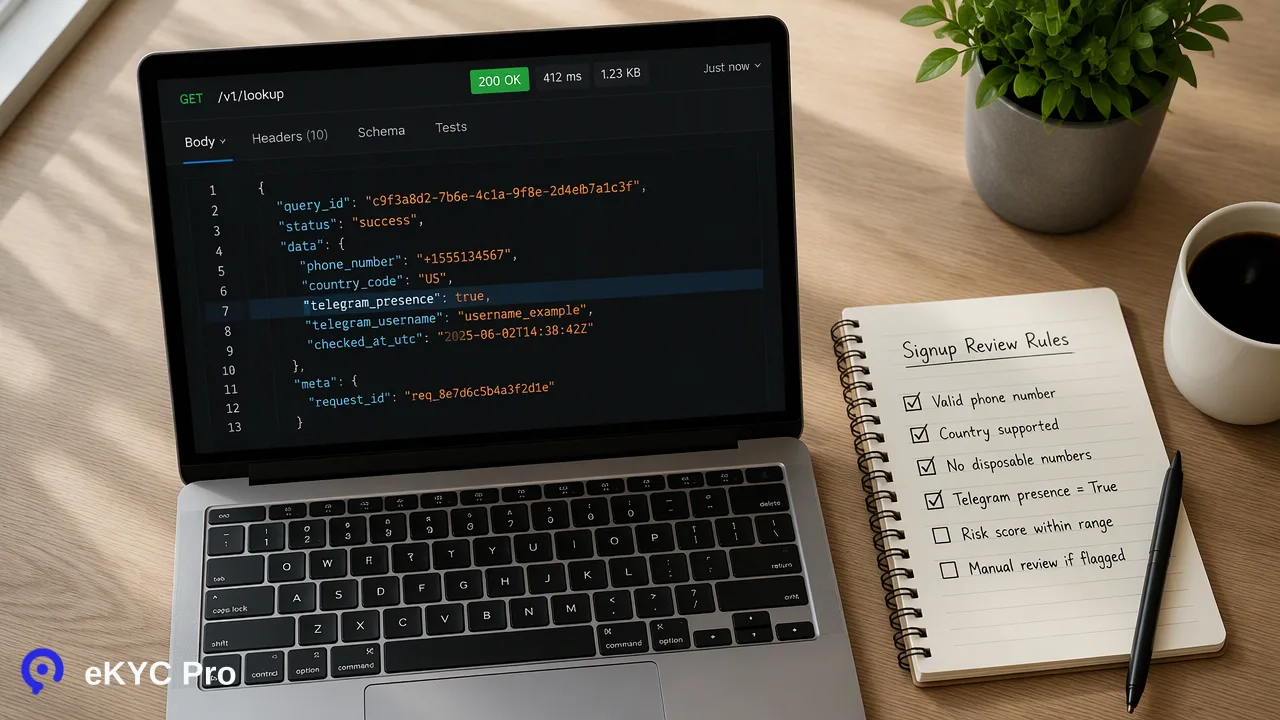
A Telegram account checker takes one phone number and reports whether that number shows a Telegram account-presence signal at the moment of the check. For a review team, the result answers a narrow question: does this number appear to be connected to a Telegram account right now? It does not tell the team who holds the number, whether the person uses Telegram actively, or whether a signup is genuine, so it works best as one input into signup, recovery, or manual-review rules.
What a Telegram account checker actually answers
Most search results for this term mix three different tools under one name:
| Tool type | Input | Question it answers |
|---|---|---|
| Username availability checker | A public @username | Is this handle taken or free? |
| Contact-sync lookup inside the app | A saved phone contact | Does this contact appear in my Telegram contact list? |
| Phone account-presence check | One phone number in international format | Does this number show a Telegram account-presence signal at check time? |
A risk or onboarding team almost always needs the third type. A username tells the team nothing about the phone number a user typed into a signup form, and adding strangers to a staff member’s personal address book is not a workable or auditable review process.
The phone account-presence check is what eKYC Pro offers as the Telegram Check: one phone number, one selected service, one real-time request through the Per-call API. The result is a platform-specific account-presence signal, read at the time of the request.
Why manual Telegram account checks fall short in review
Guides that rank for this keyword usually explain how to save a number to a phone’s contacts and wait for Telegram to sync. That method is fine for one person checking one friend. It breaks down for a business process for several reasons:
- Privacy settings change what the app shows. Telegram’s privacy controls include whether people can see a member’s phone number and whether people can add that member by phone number (Telegram API privacy keys). A contact-sync result is therefore shaped by the account holder’s settings, not only by whether an account exists.
- There is no audit trail. A screenshot from an analyst’s handset is hard to tie to a case record, a timestamp, and a decision rule.
- It mixes personal and business data. Saving applicants’ numbers into staff devices creates a data-handling problem the review team then has to manage.
- It does not fit inline flows. A signup or recovery decision that waits for a person to check a handset cannot run while the user is still on the page.
An API-based Telegram account checker moves the check into the system that already records the case, so the result, the time of the check, and the routing decision sit together.
How to read a Telegram presence result
Read the result for exactly what it is: an account-presence signal on Telegram for this number at check time.
A presence signal can support:
- Treating the number as one that is connected to an active messaging ecosystem account, which some teams weigh as ordinary for their user base.
- Choosing Telegram as one possible channel for follow-up, subject to the team’s own consent and contact rules.
- Comparing the number’s profile against other signals in the same case.
A presence signal does not show:
- Who holds the number or who created the Telegram account.
- Whether the person submitting the form controls the number. That still needs a possession step such as a one-time code.
- How often the account is used, or what it is used for.
A no-presence result means only that the check did not return a Telegram presence signal for that number. Many people simply do not use Telegram, and usage varies sharply by country. Treat a no-presence result as neutral unless the team’s own data shows it matters for a specific market or product.
An indeterminate or timed-out result should be handled by a rule written in advance, for example: continue with standard controls, or retry once later in an asynchronous review queue. Indeterminate and timed-out service checks are generally not billed.
Where the Telegram check fits in signup and recovery review
Teams usually place a Telegram account checker at one of three points:
- Signup pre-screen. After the phone number is normalized and before stronger, higher-friction controls. The result feeds a rule that sends most signups through and routes a small set to step-up or manual review.
- Contact-change and recovery review. When a user asks to replace the phone number on an existing account, the new number can be checked before the change is approved. A sudden switch to a number with a very different signal profile is a reason to look closer, not an automatic block.
- Manual review enrichment. An analyst working an escalated case can see the Telegram signal next to other case data instead of collecting it by hand.
In every placement, the Telegram signal informs a decision the team’s own policy makes. It does not approve or reject anyone on its own.
Single check, saved Combo set, or score
eKYC Pro offers three ways to use the Telegram signal, and they should not be confused:
- Per-call API: runs only the Telegram Check on one phone number and returns that service’s result. Use it when Telegram presence is the specific question.
- Combo Check API: runs a saved group of services concurrently on the same number, for example Telegram alongside WhatsApp and Viber, and returns each service’s result with its billing detail. Use it when the review rule depends on several platform signals at once.
- Phone Trust Score API: runs several live checks on one mobile number and returns a 0–100 score, with a grade from A to E. The score is decision support for customer-defined rules, not a verdict.
All three accept one identifier per request. Teams with a list of numbers call the API one number at a time.
Regional notes and input quality
Telegram presence checks depend on the number being submitted in a clean, consistent format. Before calling any Telegram account checker:
- Normalize to international E.164 format, including the country code.
- Strip spaces, punctuation, and leading trunk zeros that belong to national dialing formats.
- Record the country the user selected separately from the number, so reviewers can spot mismatches.
Numbers from China mainland (+86), Hong Kong (+852), and Macau (+853) support limited real-time single checks, so teams serving those markets should expect more cases that need a fallback rule. Telegram adoption also differs widely between countries, which is another reason to calibrate the meaning of a no-presence result per market rather than globally.
Common mistakes with a Telegram account checker
- Treating presence as identity. A presence signal is about the number on one platform, not about the person in front of the form.
- Blocking on absence. Many genuine customers have no Telegram account; a no-presence rule should rarely block by itself.
- Confusing usernames with numbers. A taken username says nothing about the phone number under review.
- Skipping the fallback rule. Without a written rule for indeterminate results, analysts handle them inconsistently.
- Re-using an old result. Account presence is read at check time; a result from months ago may not describe the number today.
- Overstating the signal in notes. Case notes should record “Telegram presence signal returned at [time]” rather than conclusions such as “confirmed user”.
FAQ
How can teams check whether a phone number has a Telegram account without saving it to a phone?
Teams can send the number in international format to an API-based Telegram account checker such as the eKYC Pro Telegram Check. The check runs on one number per request and returns an account-presence signal at check time, so no staff device or contact list is involved.
What does a no-presence result from a Telegram account checker mean?
It means the check did not return a Telegram account-presence signal for that number at that time. Plenty of people do not use Telegram, so most teams treat the result as neutral and let other signals and controls decide the route.
How should review teams handle an indeterminate Telegram check?
Write the rule before launch: continue with standard controls, retry later outside the live flow, or send the case to manual review if other signals are also unclear. Indeterminate or timed-out service checks are generally not billed.
Can a Telegram presence signal be combined with other platform checks?
Yes. A saved Combo Check set can run Telegram together with other services on the same number concurrently, and customers can use the Phone Trust Score API to receive a 0–100 score and A–E grade that feed their own routing rules.
Get Started with eKYC Pro
Explore eKYC Pro’s single-identifier APIs and choose the service-specific, combined-signal, or unified-score workflow that fits your use case.