
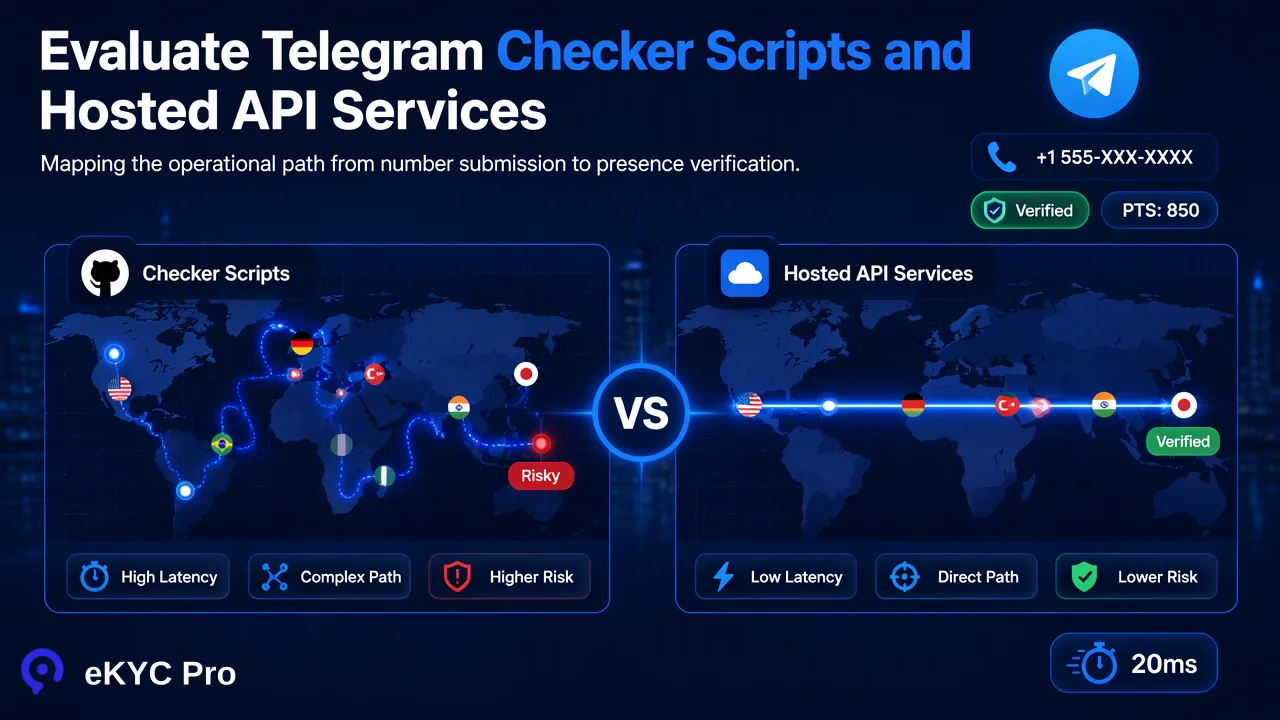
A Telegram phone number checker found on GitHub can be useful when a team is prepared to review its code, manage Telegram account sessions, and own its ongoing operation. A hosted check API is a different integration choice: eKYC Pro supplies a synchronous, single-identifier Telegram account-presence signal for one submitted phone number. Compare the two approaches by evidence quality, operational ownership, and how the result enters a review workflow rather than assuming either one proves identity or contact permission.
What the two approaches actually do
A repository labeled Telegram phone number checker may contain a script, a client-library example, or a broader account-management tool. The title alone does not establish what it checks, whether it uses an authorized account session, how it handles errors, or whether its output represents current account presence. Read the repository’s source and documentation before treating it as a production component. One public GitHub checker project, for example, documents session handling and append-only result records; that design is specific to that project and should not be generalized to every open-source checker.
eKYC Pro’s documented Telegram check is a Per-call service: one submitted phone number is checked synchronously and the resulting account-presence signal can be passed to the team’s own risk rules. It belongs to eKYC Pro’s single-identifier model, not an uploaded-file task. The Telegram checker tool can help a reader understand the question the service answers, while the Per-call API overview describes how a selected service fits an inline review flow.
Both approaches ultimately need careful interpretation. A completed presence signal concerns the submitted number at check time. It does not show who owns the number, whether the person consented to contact, whether they are active now, or whether a signup is fraudulent. Those additional decisions remain with the organization.
Inspect a GitHub script before using it with real contacts
Start with provenance. Identify the maintainer, license, last meaningful changes, dependencies, and the exact Telegram interface the script calls. Read the code paths that load phone numbers, create or reuse sessions, make requests, classify responses, and write output. A README example is not enough to establish that error handling is safe or that the script matches its advertised purpose. If the tool is only a username checker, it does not become a phone-number checker because both involve Telegram.
Review the session model. Telegram’s official API documentation describes phone-resolution operations in the client API, but a team’s chosen library and account session create operational duties. Establish who owns the account credentials, where session files live, how they are protected, and what happens when an account needs reauthorization. Avoid copying credentials into a shared repository or logs. Also review Telegram’s current terms and applicable privacy obligations for the contemplated use; a repository’s availability is not permission for every workflow.
Finally, test the script with approved, non-sensitive test data and inspect all output states. A missing account, a request error, and a rate or account restriction need separate labels. If the tool simply writes true or false for every input, an error may be mistaken for a negative result. A production integration needs clear failure handling, observability, and a process for updating dependencies when Telegram or the library changes.
Compare operational responsibilities, not just setup steps
| Decision area | Self-run GitHub checker | Hosted single-number API |
|---|---|---|
| Account or session operation | Team reviews and maintains the chosen script’s authentication model | Team manages its API access and application integration |
| Code maintenance | Team tracks dependencies and upstream behavior changes | Team maintains the caller and review rules |
| Failure classification | Team must verify script-specific output and error paths | Team reads the documented service outcome and keeps uncertainty separate |
| Data handling | Team owns local input and output storage decisions | Team still owns its submitted identifiers and downstream review records |
| Review integration | Team builds its own result adapter | Team connects one synchronous signal to its own decision flow |
The table describes the work a team should evaluate; it is not a claim that every repository has the same features or that a hosted service removes governance duties. With a self-run script, the team controls the code and can inspect its behavior, but it also inherits session maintenance, dependency updates, and operational incident response. With a hosted API, the application still needs secret handling, input validation, error states, logging, and a policy for using the signal.
The relevant cost comparison is total operational effort, not a guessed per-check price. Estimate engineering time for review, setup, maintenance, incident response, and audit needs. Consider the expected request pattern: an inline signup flow benefits from a predictable synchronous integration, while an experimental research project may value direct control of a script. These are decision criteria, not universal recommendations.
Fit a hosted signal into an inline risk review
An inline review begins with the identifier the user actually submitted. Preserve the original phone value and the normalized value used for checking, then invoke a selected Per-call service for one number. The result becomes one input to an application-owned rule or reviewer screen. If the attempt is indeterminate, keep that state separate from a completed negative account-presence result. The application can decide whether to defer, ask for another step, or use other approved evidence.
Do not invent an API response envelope, field list, or runnable payload from a general comparison article. The current eKYC Pro API documentation is the source for integration details, and the product profile establishes the single-identifier boundary. The article’s purpose is selecting an approach, not reproducing a contract that may change. An organization should review the current docs during implementation and keep API credentials on a trusted backend.
A reviewer-facing label should be narrow, such as ‘Telegram account presence observed for submitted number at check time.’ Avoid ‘identity verified’ or ‘safe customer.’ If an account-presence signal raises a question, the team’s own policy decides whether stronger checks are appropriate. eKYC Pro does not provide document, face, or liveness verification in this workflow.
Plan the evidence trail either way
A useful evidence trail identifies the source record, submitted phone number, selected check, check time, processing outcome, and reviewer action. These are suggested fields in the team’s own system, not provider output fields. The trail should show whether a result was completed or whether a technical condition left it unresolved. It should also preserve the version of the local script or integration when that affects interpretation.
For a GitHub checker, record the repository revision and local configuration used for a controlled run without copying secrets into the record. Keep the output mapping back to each source row, especially when the script deduplicates a list. Review what the tool stores by default and whether its records contain identifiers that should have limited access. If a script changes its result vocabulary after an update, document the migration before old and new outcomes are combined in one dashboard.
For a hosted Per-call integration, keep the check tied to the exact identifier submitted for that decision event. A later edit to a signup phone field should not inherit the earlier result. Distinguish technical retry attempts from fresh observations and do not overwrite an older completed result with a later error. The same data-handling discipline applies regardless of who operates the checking code.
Use a short selection checklist before committing
Ask five questions. First, is the input actually a phone number rather than a public username? Second, does the team need one check during an inline decision or a separately managed research workflow? Third, who will maintain the Telegram account session or API integration? Fourth, can the proposed tool distinguish completed positive, completed negative, and unresolved outcomes? Fifth, how will the result be mapped to a source record and reviewed without becoming an identity claim?
A self-run script is defensible when the team can inspect and operate the exact implementation, maintain its session safely, and verify its output semantics. A hosted synchronous check is defensible when the application needs one documented account-presence signal inside an existing review flow and the team can maintain the API caller and decision policy. Neither choice automatically supplies consent, account ownership, or a fraud verdict.
Revisit the choice when the workload or evidence requirement changes. A proof-of-concept script may not be suitable for production without operational controls. A hosted API may be too narrow if the team needs a different kind of evidence. The right comparison stays anchored to the reader’s task and the verified capabilities of the specific tool under consideration.
FAQ
How should teams evaluate a Telegram phone number checker on GitHub?
Inspect the exact repository’s code, dependencies, session model, error handling, and output mapping. Test approved inputs before production use, and do not assume that a repository name proves it answers a phone-number registration question.
What does the hosted eKYC Pro Telegram check provide?
It provides a synchronous Per-call account-presence signal for one submitted phone number. The completed signal can inform the team’s own rules, but it does not verify identity, ownership, consent, or a final fraud outcome.
Does an open-source checker avoid account-session work?
Not necessarily. The team must inspect the selected tool’s authentication approach and own its configuration, secret storage, updates, and operational response. Different repositories can have very different designs.
How can a review workflow avoid misusing either result?
Store the submitted identifier, selected check, time, completion state, and reviewer action separately. Keep unresolved outcomes distinct from completed negative results and do not convert account presence into identity or contact-permission proof.
Get Started with eKYC Pro
Explore eKYC Pro’s single-identifier APIs and choose the service-specific, combined-signal, or unified-score workflow that fits your use case.