
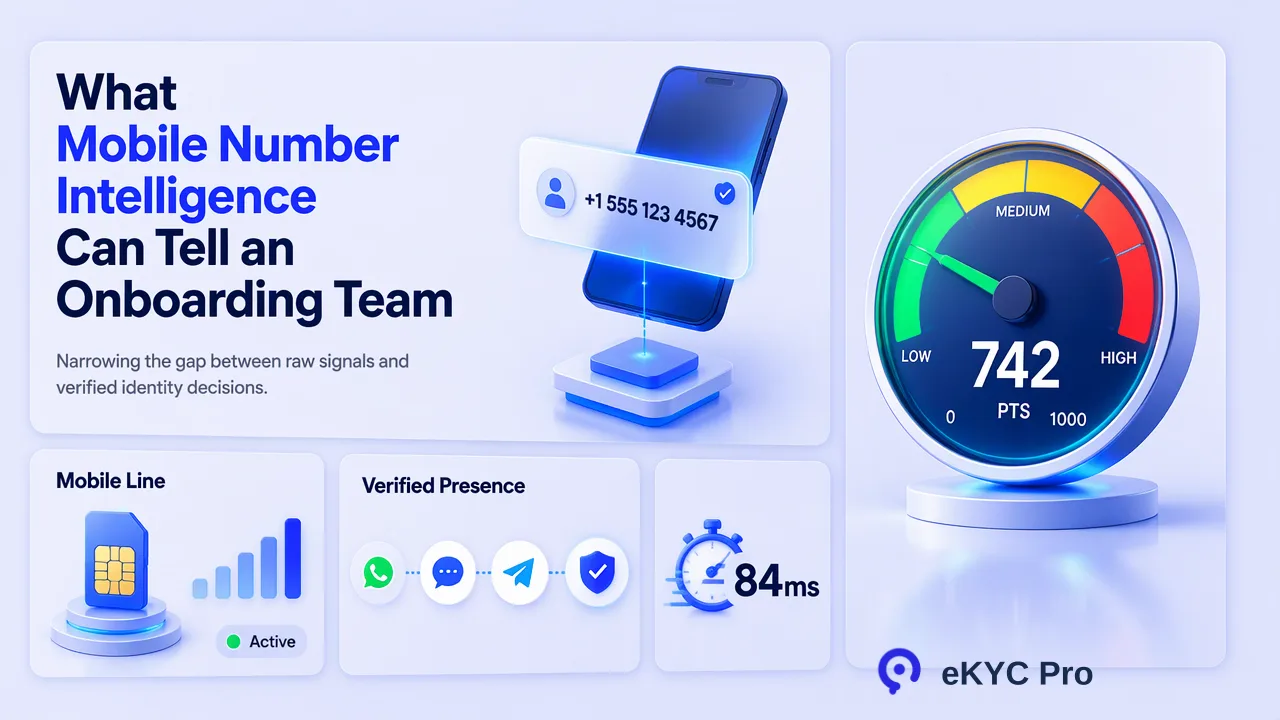
A customer enters a phone number on an application. Before you decide whether to approve the application or ask for another check, decide what you need to know about that number. A numbering-plan lookup can help interpret its carrier or line type. An account-presence check can tell you about a particular service. Establishing that the applicant controls the number, or that the applicant is the named customer, takes different evidence.
Start with the question behind the phone field
An operations team introducing a callback step might only need to know whether a number looks suitable for its chosen channel. Its case is quite different from a support desk deciding whether to change the recovery number on an existing account. An incorrect callback preference is usually easy to correct. Changing a recovery factor can transfer access to someone else. A phone field appears on both forms, but the decision behind the field determines how much evidence is enough.
Write the immediate decision down before choosing a lookup. “Which channel should we offer?” is answerable in a way that “Can we trust this person?” is not. If the answer concerns present control, arrange a suitable challenge. If it concerns the legal identity of the person completing the form, use the identity evidence your process requires. A phone observation can add context to either case without answering every part of it.
Read a lookup in the context of its data source
Our per-call services check one identifier for the selected service. For example, carrier lookup provides numbering-plan attributes such as carrier and line type where available. The service documentation describes its data sources. An operation built on a numbering plan has a different evidential scope from a live query to the operator about a recent account event.
Consider a number identified as a mobile line. That observation can help a reviewer decide that a mobile challenge is a sensible option to offer. It does not show that the number is reachable at this moment or that the person typing it is holding the device. A number can be ported or reassigned. Without a source that specifically reports the relevant event, an ordinary carrier result cannot tell you when a port or SIM change took place.
The same principle applies to a service-specific account check. A positive registration signal for a supported platform concerns the submitted number and that platform. It supplies a reason to consider the channel, subject to the customer’s preferences. A missing or unavailable observation should stay missing in the review record. Replacing it with a negative answer changes the meaning of the evidence.
Choose the next action that answers what is still unknown
Imagine two applications with the same line-type result. In the first, a returning customer has already authenticated and wants notifications on a different channel. Asking them to confirm that destination can establish the fact needed for the change. In the second, someone requests control of an existing account using a newly entered phone number. Sending a code to the new number could show that the requester controls the proposed destination, while leaving their relationship to the existing account completely unresolved. Use the established recovery procedure in that case.
| Observation | Decision it can inform | Question still open |
|---|---|---|
| Numbering-plan data reports a mobile line | Whether to offer a mobile channel | Who currently controls the number |
| A supported service reports an account | Whether the channel merits confirmation | Whether this applicant owns that account |
| Applicant completes a fresh challenge | Whether the challenge was completed using that destination | Whether the applicant matches a particular legal identity |
For an onboarding review, keep four pieces together: the submitted identifier or its controlled reference, the service checked, the returned observation and the time it was obtained. Record the separate business decision and its owner. A reviewer who sees “mobile line, checked yesterday” can decide whether to repeat a channel check. A reviewer who sees only “verified” has to guess what was established.
Try this exercise with one real decision in your onboarding flow. Ask the person who handles exceptions to point to the evidence for each conclusion. If the source only speaks to line type, narrow the conclusion to line type. If the action needs present control or identity, add the corresponding step where it matters. That makes a small set of clearly understood phone signals more useful than a larger collection of fields whose meaning nobody can defend.
Get Started with eKYC Pro
Explore eKYC Pro’s single-identifier APIs and choose the service-specific, combined-signal, or unified-score workflow that fits your use case.